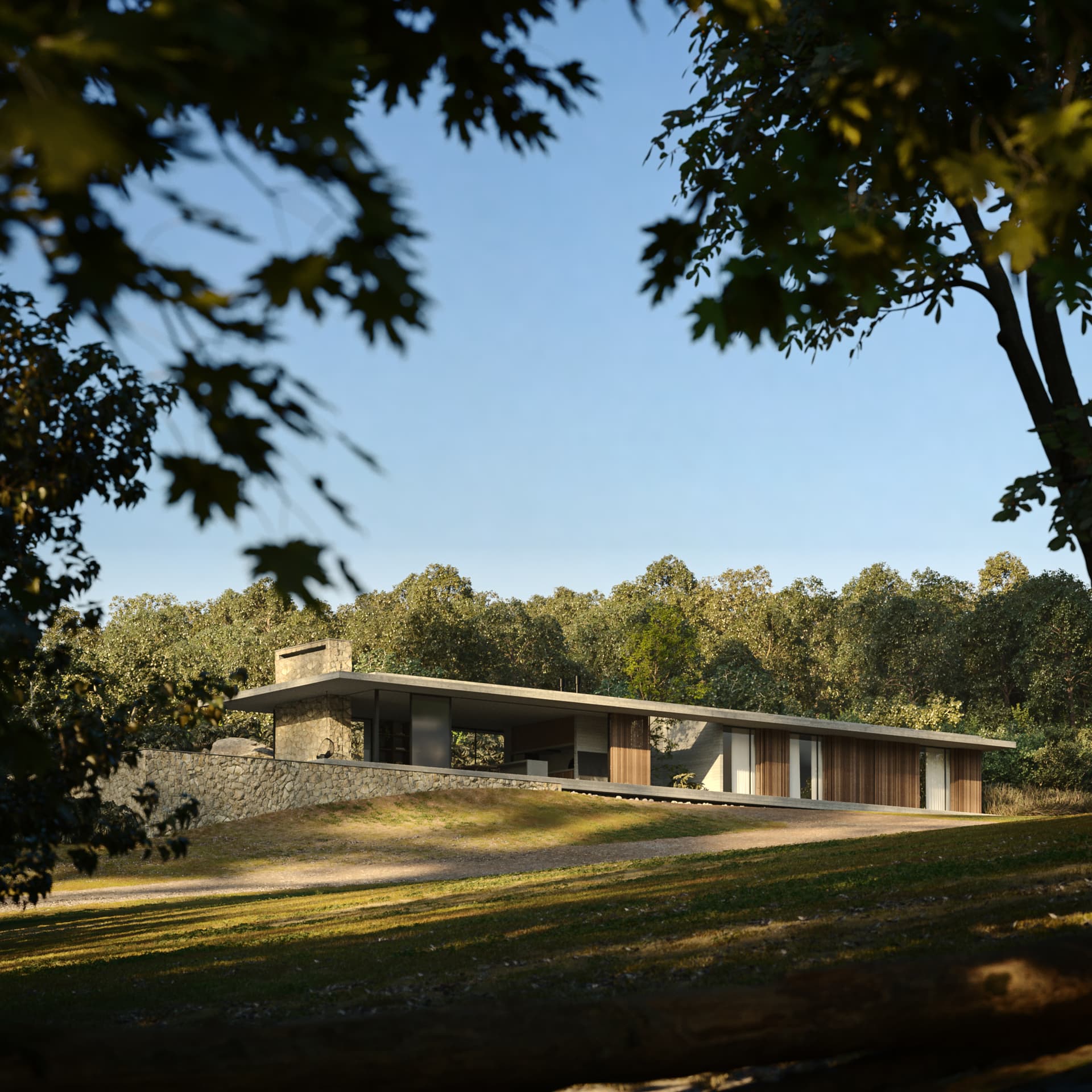
An Architecture of the South
Our aesthetic doesn't come from tropical modernism. It comes from the South.
From the weight of the mountains, from the fog that covers the valley, from the European heritage that built in stone because stone endures. This is an architecture closer to Buenos Aires and Montevideo than to the Rio–São Paulo axis. More mineral. More rooted. More permanent.
Brazilian tropical modernism was built for heat, shade and lightness — the brise-soleil, the thin slab, the house that opens up to dissipate warmth. It's a correct response to a climate that isn't ours. In the serra gaúcha, fog doesn't ask permission, winter has weight, and the stone that Europe brought in immigrants' baggage still stands a century later.
That's why we design with mass, not lightness. With materials that retain heat rather than disperse it. With topography as shelter, not as an obstacle to overcome. The house of the South doesn't float on pilotis — it anchors itself to the ground, leans into the slope, uses the earth as part of its thermal structure.
There's a lineage in this that crosses borders. The Southern Cone built its own modernity — mineral, sober, wintry — that has more to do with what we make than any tropical postcard. This isn't nostalgic regionalism. It's knowing where one speaks from.
We are in the Serra Gaúcha. Our architecture has no borders.
.
.